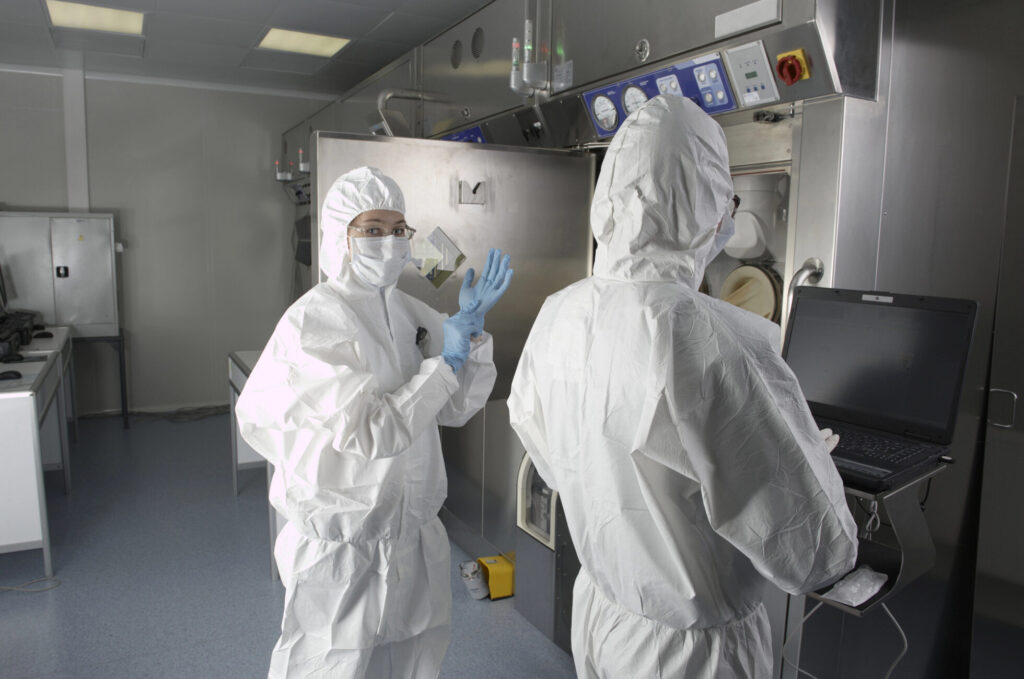

Are Your Hazardous Drug Compounding Areas Ready for Your Next State Board Survey?
Your state board survey is scheduled for next month, and you need to verify that your hazardous drug compounding areas meet current USP 800 ventilation standards. Between managing clinical operations and staying current on evolving regulations, the technical specifications for air changes, pressure differentials, and exhaust configurations can be difficult to track. A single ventilation failure during survey could halt chemotherapy compounding operations until recertification.
USP 800 ventilation requirements establish specific standards for air changes, pressure differentials, exhaust configurations, and HEPA filtration in hazardous drug handling areas. [1] These engineering controls form the foundation of containment strategy, protecting pharmacy personnel from exposure while maintaining the continuous operations that cancer patients depend on. This guide explains the exact ventilation specifications your facility must meet, the testing methods that verify compliance, and the practical considerations for pharmacy operations managing both sterile and non-sterile hazardous drug compounding.

What Are the Room Requirements for USP 800?
USP 800 room requirements for containment secondary engineering controls (C-SEC) include:
External ventilation: All air must be exhausted outside the building
Minimum air changes: 12 air changes per hour (ACPH) for non-sterile compounding areas; 30 ACPH for ISO Class 7 buffer rooms when sterile compounding follows both USP 800 and USP 797
Negative pressure: 0.01 to 0.03 inches of water column relative to all adjacent areas
Physical separation: Different room from other preparation areas
The C-PEC (hood or cabinet) must operate continuously if it supplies negative pressure to the room or if used for sterile compounding. These requirements apply to both sterile and non-sterile hazardous drug compounding.
Externally Vented vs Redundant HEPA Configurations
Choosing the right ventilation configuration affects both your initial facility investment and long-term operational flexibility. USP 800 permits two approaches, but only one works for sterile compounding. [2]
External Venting Requirements (Preferred Method)
External venting exhausts all air outside the building through dedicated ductwork, removing contaminated air entirely rather than recirculating it.
When it’s required:
- Mandatory for all sterile HD compounding (no exceptions)
- Acceptable for non-sterile HD compounding
- Works with all equipment types: Class II BSC, CVE, and CACI
Facility infrastructure needs:
- Makeup air to replace exhausted volumes
- HVAC capacity for conditioned replacement air
- Ductwork routing to roof termination
- Proper discharge velocity to prevent reentry
Benefits: Maximum personnel protection, no internal filter management, operational flexibility for sterile or non-sterile compounding.
Challenges: Higher installation costs, increased HVAC demands, facility modifications requiring building permits and engineering support. Multi-story buildings face complex ductwork routing through mechanical spaces.
Redundant HEPA Filtration (Non-Sterile Only)
Two HEPA filters in series within the C-PEC. Only permitted for non-sterile hazardous drug compounding—cannot be used for sterile preparations.
The system captures particulates through sequential filtration before returning air to the room. Redundancy provides backup protection if the first filter fails.
When this option makes sense:
- Leased spaces prohibiting ductwork installation
- Multi-story buildings with difficult roof access
- Cost constraints on facility modifications
- Portable or relocatable operations
Significant limitations:
- Restricted to non-sterile compounding only
- Ongoing filter replacement costs and logistics
- May not adequately contain volatile or gaseous HDs
- HEPA filters remove 99.97% of particles at 0.3 microns but don’t capture vapors
Making Your Configuration Decision
Sterile compounding? External venting required—no choice.
Non-sterile only? Evaluate these factors:
- Future compounding scope (might add sterile later?)
- Facility modification capabilities
- Volatile/gaseous HD inventory
- Installation budget vs. ongoing filter costs
- State board surveyor preferences
Most hospital pharmacies choose external venting for maximum flexibility. Even if you only compound non-sterile preparations today, external venting keeps your options open.
Critical point: The C-SEC (room) must always be externally vented regardless of C-PEC configuration.
Minimum Air Changes Per Hour for HD Areas
Air changes per hour directly impact how quickly your facility removes airborne contamination. Too few air changes leave contamination lingering. Too many drive up energy costs without additional safety benefits.
Understanding Air Changes Per Hour (ACPH)
ACPH measures how many times the complete room air volume gets replaced each hour. A buffer room with 1,000 cubic feet of air receiving 500 cubic feet per minute of supply achieves 30 air changes per hour.
Your certification technician measures actual airflow at supply diffusers and exhaust grilles, then calculates whether your system meets minimum requirements. ACPH is different from pressure differential—though related, pressure comes from the balance between supply and exhaust while ACPH measures total volume exchange.
Non-Sterile Compounding Areas (12 ACPH Minimum)
USP 800 requires minimum 12 ACPH for C-SEC rooms used for non-sterile hazardous drug compounding.
Applies to:
- Non-sterile buffer rooms housing CVE or Class I BSC
- Unclassified containment segregated compounding areas (C-SCA) [3]
- HD storage rooms for antineoplastic drugs and APIs
Twelve air changes provides baseline contamination dilution without ISO classification requirements.
C-PEC continuous operation: The C-PEC must operate continuously if it supplies negative pressure to the C-SEC or if used for sterile compounding. While USP 800 doesn’t explicitly address reducing room air changes when unoccupied, maintaining continuous ventilation is considered best practice for contamination control.
Verification happens during certification testing. Common failure points: undersized HVAC systems, ductwork restrictions, and filter loading over time.
Sterile Compounding Areas (30 ACPH Minimum)
USP 800 requires minimum 30 ACPH for ISO Class 7 buffer rooms used for sterile hazardous drug compounding.
The higher rate maintains both particle cleanliness (ISO classification) and negative pressure with adequate exhaust volume. Supply air provides ISO 7 cleanliness through HEPA filtration. Exhaust maintains negative pressure. The net difference creates your pressure differential.
This must coordinate with USP 797 standards. ISO Class 7 ante-rooms also require 30 ACPH but with positive pressure. Your pressure cascade: ante-room (positive) → buffer room (negative) → adjacent areas (neutral).
Implementation Challenges
Many hospital pharmacies built before USP 800 lack adequate HVAC capacity. Facilities from the 1980s and 1990s typically used shared air handlers serving multiple spaces.
Solutions for inadequate ACPH:
- Dedicated air handling units for HD areas
- Supplemental fan filter units (FFUs)
- Variable speed drives on existing equipment
- Space reconfiguration to reduce room volume
Monitoring requirements:
- Temperature monitoring (indicates HVAC operation)
- Continuous pressure differential monitoring
- Six-month certification testing
- Automated systems vs. manual daily checks
Operating at 30 ACPH versus 12 ACPH significantly impacts energy consumption and filter replacement frequency. Budget for both installation and ongoing operational expenses.
ACPH Requirements Quick Reference
- Non-sterile HD compounding (C-SEC): 12 ACPH minimum
- Sterile HD compounding (ISO 7 buffer): 30 ACPH minimum
- HD storage rooms (antineoplastic/API): 12 ACPH minimum
- ISO 7 ante-room: 30 ACPH (positive pressure)
For facilities performing sterile HD compounding under both USP 797 and USP 800, certification testing on six-month cycles verifies compliant air changes, pressure differentials, and exhaust configurations per USP 797 requirements. Call (281) 474-3329 to coordinate testing around your clinical operations.
C-SEC Requirements for Non-Sterile HD Compounding
The containment secondary engineering control (C-SEC) is the room that houses your containment primary engineering control (C-PEC). While the C-PEC is your hood or cabinet where compounding actually happens, the C-SEC provides the controlled environment surrounding it.
Core C-SEC Requirements
USP 800 establishes four mandatory requirements for any C-SEC used for non-sterile hazardous drug compounding.
External ventilation removes all air outside the building rather than recirculating it. Your exhaust ductwork must terminate above the roof line with adequate discharge velocity to prevent reentry.
Minimum 12 air changes per hour maintains continuous contamination dilution. This requirement applies whenever hazardous drugs are present in the room, not just during active compounding.
Negative pressure of 0.01 to 0.03 inches of water column relative to all adjacent areas prevents contaminated air from escaping. The room must be negative compared to corridors, ante-rooms, and any adjoining spaces.
Physical separation from other areas means fixed walls creating a distinct room. You cannot use curtains, partitions, or designated areas within larger spaces. Non-sterile hazardous drug compounding requires a separate, enclosed room.
Each requirement serves a specific containment purpose. External ventilation eliminates exposure to recirculated contamination. Adequate air changes dilute airborne particles and vapors. Negative pressure contains contamination within the designated space. Physical separation prevents cross-contamination with other pharmacy operations.
The C-PEC must operate continuously if it supplies negative pressure to the C-SEC or if used for sterile compounding. While USP 800 doesn’t explicitly prohibit reducing room air changes when unoccupied, maintaining continuous ventilation in HD storage and compounding areas is widely considered best practice for containment.
Room Design and Construction Standards
C-SEC construction must support contamination control and facilitate cleaning.
Surface requirements:
- Smooth, impervious walls, floors, and ceilings
- Epoxy-coated walls, sealed flooring, smooth ceiling tiles
- Resistant to chemical damage
Sink and eyewash placement:
- Accessible emergency eyewash and hand washing
- Water sources/drains minimum 1 meter from C-PEC
- Prevents splash contamination and humidity
Fixed walls are required—no temporary partitions. Some pharmacies attempted “hazardous drug zones” using curtains within larger areas. USP 800 eliminates this approach.
Monitoring and Certification Requirements
USP 800 recommends routine environmental wipe sampling for HD surface residue, performed initially as a baseline and at least every six months thereafter to verify containment.
For facilities also performing sterile compounding under USP 797, additional requirements include:
- Daily pressure differential monitoring
- Daily temperature monitoring
- Six-month certification of primary and secondary engineering controls
Many facilities adopt pressure differential monitoring as best practice even for non-sterile HD compounding to ensure continuous containment.
Certification testing verifies:
- Actual air changes per hour
- Negative pressure relative to all adjacent areas
- HEPA filter integrity (when applicable)
- External exhaust termination
State boards of pharmacy and accrediting bodies review certification records during surveys. Facilities should maintain current documentation demonstrating ongoing compliance.
Emergency procedures should be established before problems occur. Most ventilation failures result from filter loading, damper changes, or HVAC malfunctions. Having relationships with qualified certification providers allows rapid response when chemotherapy compounding cannot wait.
Schedule Your USP 800 Cleanroom Certification
Maintaining compliant ventilation systems requires regular verification. Allometrics provides comprehensive cleanroom certification services for hospital pharmacies and compounding facilities across Texas and nationwide, including pressure differential measurements, airflow verification, and HEPA filter integrity testing.
Our certification testing verifies your C-SEC meets all ventilation requirements. For sterile HD compounding facilities following both USP 797 and USP 800, we coordinate six-month testing cycles around your clinical operations to minimize disruption to patient care.
Since 1976, we’ve served pharmaceutical and healthcare facilities. Our CETA-registered cleanroom certification professionals and NSF-accredited technicians understand hospital pharmacy operations and healthcare scheduling constraints. Our A2LA ISO 17025 accredited laboratory provides NIST-traceable measurements for added confidence in your compliance documentation.
Call (281) 474-3329 to request your certification quote.
Common Questions About USP 800 Ventilation and Cleanroom Standards
USP 800 mandates that containment secondary engineering controls include external ventilation exhausting all air outside the building, minimum air changes of 12 ACPH for non-sterile areas or 30 ACPH for ISO Class 7 sterile buffer rooms, negative pressure of 0.01 to 0.03 inches of water column relative to adjacent areas, and physical separation through fixed walls creating a distinct room rather than partitions or curtains.
USP 800 focuses specifically on hazardous drug containment and requires all C-SECs to be externally vented and negatively pressurized, while USP 797 addresses sterile compounding with positive pressure buffer rooms. When performing sterile hazardous drug compounding, facilities must satisfy both standards simultaneously—maintaining ISO Class 7 cleanliness from USP 797 while achieving negative pressure and external venting required by USP 800.
Cleanrooms used for sterile hazardous drug compounding require 30 air changes per hour to maintain ISO Class 7 classification. Non-sterile hazardous drug compounding areas require a minimum of 12 ACPH. The higher rate for sterile areas maintains both particle cleanliness and adequate exhaust volume to support negative pressure, while non-sterile areas need only baseline contamination dilution without ISO classification.
Resources
- https://pmc.ncbi.nlm.nih.gov/articles/PMC5398627
- https://www.jhoponline.com/web-exclusives/navigating-the-new-requirements-for-usp-800-drugs
- https://www.csemag.com/usp-pharmacy-797-800-standard-compliance-how-should-hospitals-revise-facilities-in-face-of-shifting-regulations/